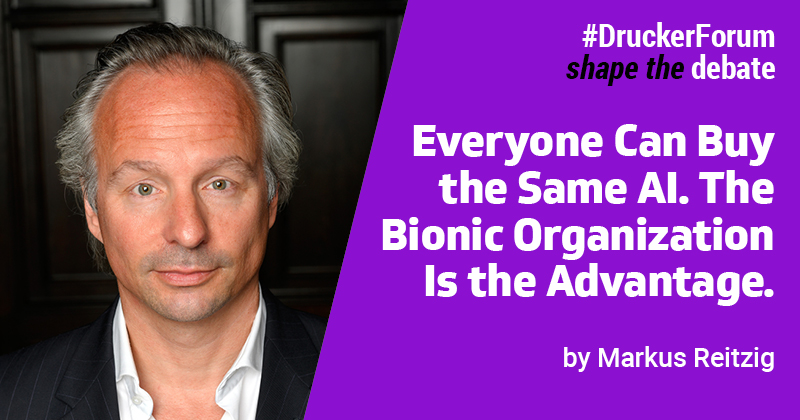
Everyone Can Buy the Same AI. The Bionic Organization Is the Advantage.
by Markus Reitzig

No firm can afford to ignore AI. But does it follow that adopting AI will create competitive advantage?

Probably not.

Increasingly powerful models, platforms, and tools are becoming available to a growing number of firms. Competitors can buy them too. If access to AI becomes widespread, access itself is unlikely to provide a lasting advantage.

The more interesting question is what kind of organization a firm builds around it. […]

Continue reading

When Intelligent People Create Unintelligent Institutions
by Martin Shelford

You have almost certainly sat in the meeting.
A strategy is being reviewed. The numbers are assembled, the slides are clean, the language is confident. Around the table sit fifteen people, most of whom privately suspect the plan stopped describing reality months ago. Nobody says so. Not because they are cowards or lack the analysis, but because the room has already told them what contribution it wants.[…]

Continue reading

When AI Makes Control Cheap
By Guido Bosbach

A retail chain wanted its apprentices to show up more reliably, so it paid them a bonus for attendance. Absences went up by about half, which came to more than five additional days per person per year, and they stayed up after the bonus ended. Jakob Alfitian, Dirk Sliwka and Timo Vogelsang ran it across 232 stores and 346 apprentices and published it in Management Science as “When Bonuses Backfire”.[…]

Continue reading

The Cost of Being Sure
By Guido Bosbach

An executive is asked how far along his company is with AI. He answers precisely: two pilots, one policy, forty people trained. Every word is accurate, and it describes a tenth of what is going on there. In the same week, a function that arrived with a March software update is pre-sorting job applications in his HR department. Nobody decided this. Nobody concealed it either. It came with the release notes.[…]

Continue reading

The Real Constraint on AI Is Not Technology. It Is Human Nature.
The last mile of artificial intelligence is not artificial
By Yuval Dvir

A few years ago, after a transformation program delivered unusually strong returns, a senior peer leaned over and said the numbers looked too good. Keep a lid on them, he advised, in case other teams got nervous. The technology had worked. The politics had not. That single remark contained the problem most AI programs still refuse to name.[…]

Continue reading