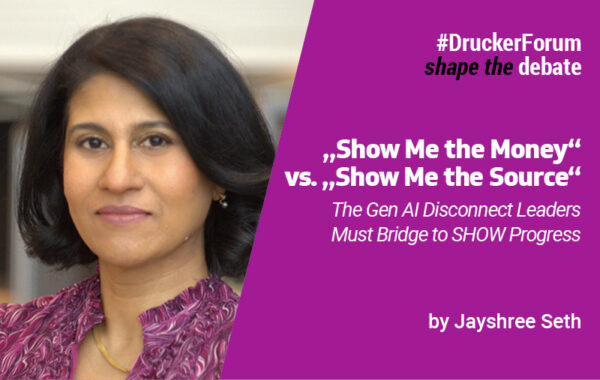
“Show Me the Money” vs. “Show Me the Source” The Gen AI Disconnect Leaders Must Bridge to SHOW Progress
By Jayshree Seth

In Jerry Maguire’s memorable words, leadership is demanding that generative AI show them “the money.” According to PwC’s 2026 Global CEO Survey of more than 4,400 CEOs, 56% report seeing no significant financial benefit from AI to date. The mandate is clear: prove the return, and prove it quickly.
[…]
Continue reading

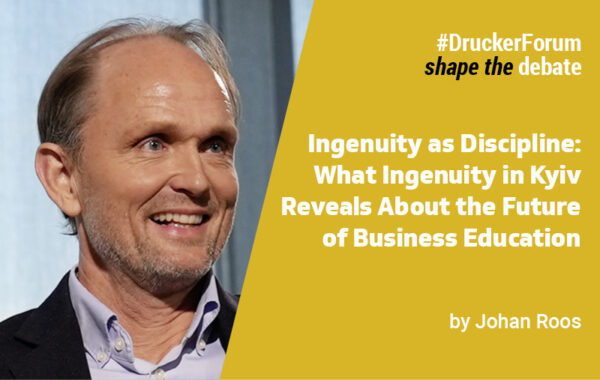
Ingenuity as Discipline: What Ingenuity in Kyiv Reveals About the Future of Business Education
By Johan Roos

First, a moment of silence for those who have fallen. Then, before the debate could begin, the air raid siren protocol: instructions for what to do when Russian missiles or drones approach.
That was a first. My family had sensibly vetoed my attending in person, so I was there on large screens, at a safe distance, when I served as Intellectual Provocateur at a public event hosted by the Graduate Business School of Kyiv School of Economics.
[…]

Continue reading

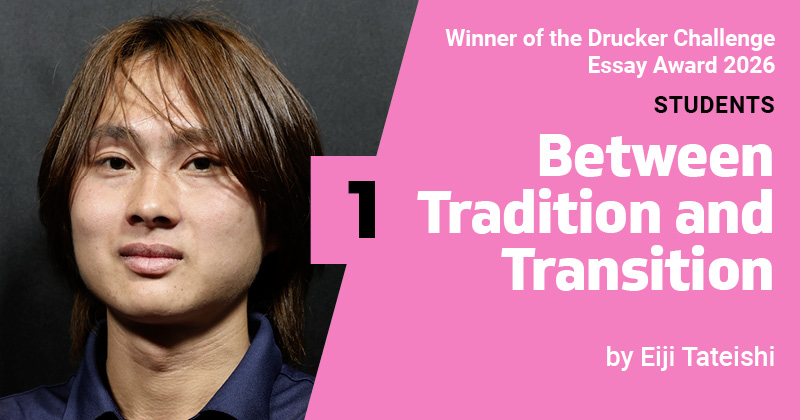
Between Tradition and Transition
by Eiji Tateishi

The scorching sun radiated onto the shoulders sculpted by years of repetition, decades of the same motion, the same net, and the same lake, etched as taut lines of muscle. Beads of sweat glistened on their bodies as they pulled in unhurried but precise unison, like a well-oiled machine, while I, gushing with sweat, ground like a rusted gear that struggled to catch.[…]

Continue reading

The Worldview Problem: Part One
By Joseph Pistrui and Dimo Dimov

Facing their deepest challenges, organisations seek to pull themselves up from the vortex of disruption. The idea is seductive. It echoes the feat of Baron Münchhausen who, stuck in a swamp, pulled himself (and his horse) up by his hair. If only we can pull harder—revisit strategy, strengthen governance, elaborate plans, double effort. One can hear Archimedes laughing: he understood a long time ago that leverage needs to come from the outside.[…]

Continue reading

The Future Belongs to Those Who Can Reorganize Themselves
By Zoya Mesaric

I encounter the same pattern regularly in executive work. Under real pressure — the kind that threatens identity as much as outcomes — most high-performing people do not become more creative. They become more rigid.
They return to what worked before. They narrow their field of attention, tighten decision-making, and apply yesterday’s solutions with increasing force to problems those solutions were never designed to solve.[…]

Continue reading

Humanistic Management in the Age of AI
What AI cannot replace, and the traditions converging on the answer
By Johan Roos

A CFO presents the plan. One hundred AI agents will take over the routine work of the accounting and finance function, the reconciliations, the first-draft reports, the month-end close. The headcount math is clean, the savings are real, and several capable people will be made redundant. Others will be reskilled for more advanced work. Around the table everyone agrees the firm should keep people at the center. No one can say what that means for the decision in front of them. The phrase is true, comfortable, and useless.[…]

Continue reading