
 Posted by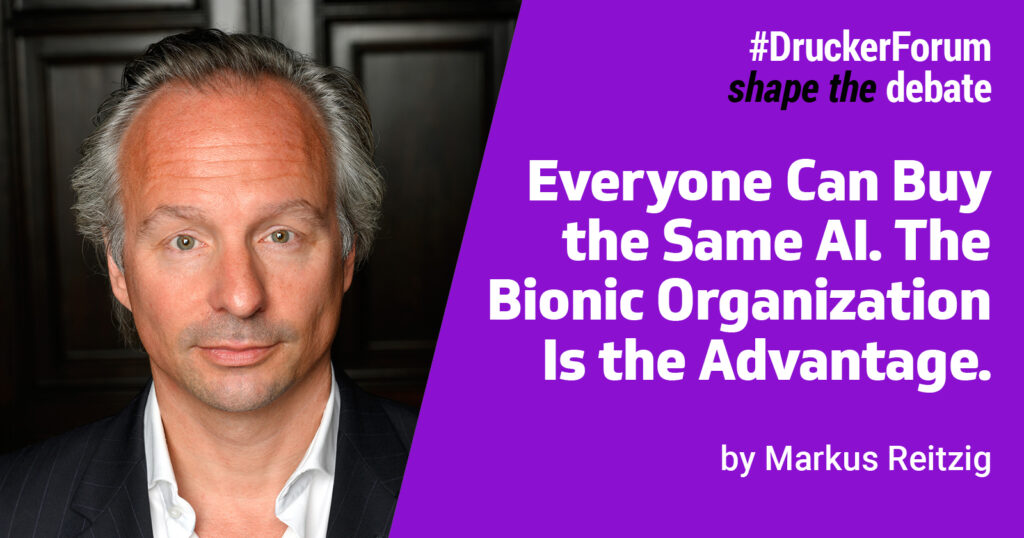
No firm can afford to ignore AI. But does it follow that adopting AI will create competitive advantage?
Probably not.
Increasingly powerful models, platforms, and tools are becoming available to a growing number of firms. Competitors can buy them too. If access to AI becomes widespread, access itself is unlikely to provide a lasting advantage.
The more interesting question is what kind of organization a firm builds around it.
The scarce capability is integration
AI can predict, search, recognize patterns, generate alternatives, and automate routines. But these capabilities do not make human capital irrelevant. For now, they change where it matters.
Human knowledge and experience remain important complements to AI in many settings. Some of these complementarities will undoubtedly diminish as the technology improves. Others will emerge.
The managerial challenge today is therefore to discover where humans and AI together outperform either alone — and to organize work so that this complementarity can actually be realized.
My friend and colleague Phanish Puranam is among those who use the term bionic organization for organizations that combine human and machine intelligence. Their advantage lies neither in technology alone nor in people alone. It lies in how algorithms, human capabilities, and organizational structure fit together.
AI changes more than jobs
Much of the current discussion starts with the individual employee. Which tasks can AI perform? How much faster can a coder, analyst, lawyer, or customer-service agent work with an AI assistant?
These are important questions. But they address only one part of the problem.
At the level of the job, AI may change how tasks are divided between humans and machines.
At the level of the workflow, it may change who communicates with whom, how information moves, where handoffs occur, and which exceptions require human intervention.
And, eventually, AI may affect the operating model itself. If information can travel differently and some coordination can be automated, firms may no longer need the same managerial layers. Hierarchies may be dismantled. Decision rights may move. Incentives may have to change. Teams may (or may not) become more autonomous.
These are organization-design questions, not technology questions.
There is no blueprint
This leaves executives with a difficult task. They must design organizations around a technology whose organizational consequences they cannot yet fully anticipate.
Copying apparent leaders using traditional case-based thinking will not solve the problem. What works in one company may fail in another because the tasks, workflows, people, incentives, and existing structures differ.
Bionic organizations therefore need to be designed. But more often than not the appropriate design will still have to be discovered.
Ford offers a useful illustration. Public reporting suggests that the company hired, rehired, or promoted hundreds of veteran engineers after AI and automated quality systems proved insufficient for some of the quality improvements it sought. The interesting point is not that AI failed, but that experience revealed where human expertise still complemented the technology. That is precisely the kind of discovery firms need to organize for.
Disciplined experimentation
This is ingenuity in practice: discovering a better human–AI arrangement when no blueprint exists. But ingenuity is not the same as improvisation. It benefits from disciplined experimentation.
For that leaders first and foremost need a plausible hypothesis. In the case of designing bionic organizations, plausible questions are: what exactly should AI improve? At what level — job, workflow, or operating model? Through what mechanism? And what evidence would make us more confident that the change is working?
Too often, organizations introduce AI first and ask these questions afterwards.
Experimenting inside a real organization
The difficulty is that good experiments become harder as we move from tasks to workflows and operating models.
At the individual level, comparing work with and without AI may be relatively straightforward. But changing a workflow may also require new incentives, roles, training, or decision rights. At the organizational level, these elements interact even more strongly.
A perfectly clean experiment may therefore be impossible to run at times — or simply too costly, slow, disruptive, or politically difficult to run.
But here is the good news. The managerial challenge is not to demand perfect evidence. It is to understand what an experiment can and cannot tell us, and whether better evidence is worth the additional cost.
Importantly, there is a human constraint as well. Employees who suspect that helping the organization discover what AI can do may eventually threaten their own jobs may not experiment openly, reveal failures, or share the tacit knowledge needed to redesign the work.
Trust, incentives, and perceived fairness therefore affect not only adoption. They affect what the organization is able to learn.
There is a distinctly Druckerian idea underneath this argument. Management’s task is not merely to acquire new resources, but to make human capabilities productive by organizing them well. AI changes the resources available to us; it does not remove that managerial task.
The organization becomes the innovation
The next phase of AI competition will thus not be won simply by deploying better technology.
It will be won by firms that become better at discovering where AI should substitute, where it should complement, what people need in order to contribute, and how workflows, incentives, decision rights, and structures need to change as a result.
And even as today’s human-AI complementarities evolve, one boundary is likely to remain. Organizations may increasingly delegate tasks and decisions to machines, but rights, authority, and ultimate responsibility will still have to reside with people.
AI may become available to everyone.
The ability to build the right organization around it will not.
About the author:
Markus Reitzig is Professor of Strategic Management at the University of Vienna, with past permanent and visiting appointments at London Business School, Copenhagen Business School, and INSEAD. His current research focuses on flatter, more agile, more human organizations, and he has published in Harvard Business Review, MIT Sloan Management Review, and McKinsey Quarterly. Through his book Get Better at Flatter and his work with executives, he brings research straight into the C-suite.
The closing boundary, that rights, authority and ultimate responsibility stay with people, is IMHO where the design work begins, not where it ends. Responsibility only resides with a person if that person can act on it. If overruling the system is safe only when the person turns out to be right, people stop overruling, and responsibility becomes a signature under a decision the machine has already made. For the experiments you describe, this means the pilot measures agreement, not complementarity.
So each experiment needs a rule for dissent before it starts: who may overrule, on what grounds, and who carries the consequence if the override is wrong. The same holds for the time to check. If it is not budgeted, it is paid for in speed.