

 Posted by
A few weeks ago, I asked my AI agent to shortlist vendors for an event this fall.
It came back in under a minute, having quietly ruled out a firm I have worked with for years. The reasoning came down to one compressed verdict: an average rating and an old article about a project that went sideways.
The agent was not wrong about the data. It was wrong about the company. It missed how that team recovered the troubled project and it didn’t see the partner who answers his phone at midnight. All of it lived in interactions the machine never saw, and none of it fits inside a rating.
My agent did not read their reputation. It read a score and acted on it. No meeting, no call, no chance to change anyone’s mind. That moment is coming for every leader, and most will never know it happened. The deal does not fall through. It never forms.
The Definition Problem
Reputation is not a number, a star average, or a rank on somebody’s leaderboard. It is a living record of trust, rewritten with every interaction. Your reputation with a twenty-year customer is not the one held by someone who met you last Tuesday, and both are accurate.
Peter Drucker put the human version plainly in The Essential Drucker. “Trust is the conviction that the leader means what he says.” A conviction, formed inside somebody’s head out of everything they have watched you do. Reputation is that conviction held by thousands at once. A score is static and universal, and that gap really is the whole argument.
That gap matters most where ingenuity lives. Ingenuity is, by definition, what no record has seen before: the unconventional fix, the problem solved sideways. A static score can only reward what has already been counted. A living record can register the new, and an economy that hopes to run on ingenuity needs a definition of reputation that can see it.
Three Eras, and We Are in the Middle One
In the search era, reputation was a ranked list of links you could see, audit, and push down the page.
In the answer era, nobody sees ten blue links. They see one synthesized paragraph, a machine’s reading of you with the context stripped out.
The agent era arrives next. Cloudflare marked the crossover in June, when automated traffic passed human traffic on its network for the first time, 57.4 percent to 42.6. Here AI does not describe your reputation to a human. It acts on it. A procurement agent shortlists vendors, a shopping agent picks the brand, a hiring agent filters candidates.
The first impression stops being an impression. It becomes a trust decision executed in milliseconds. And an agent cannot form a conviction.
Where the Definition Starts Costing Money
A procurement agent does not need your average rating. It needs to know whether you delivered for companies its size, in its industry, under its constraints.
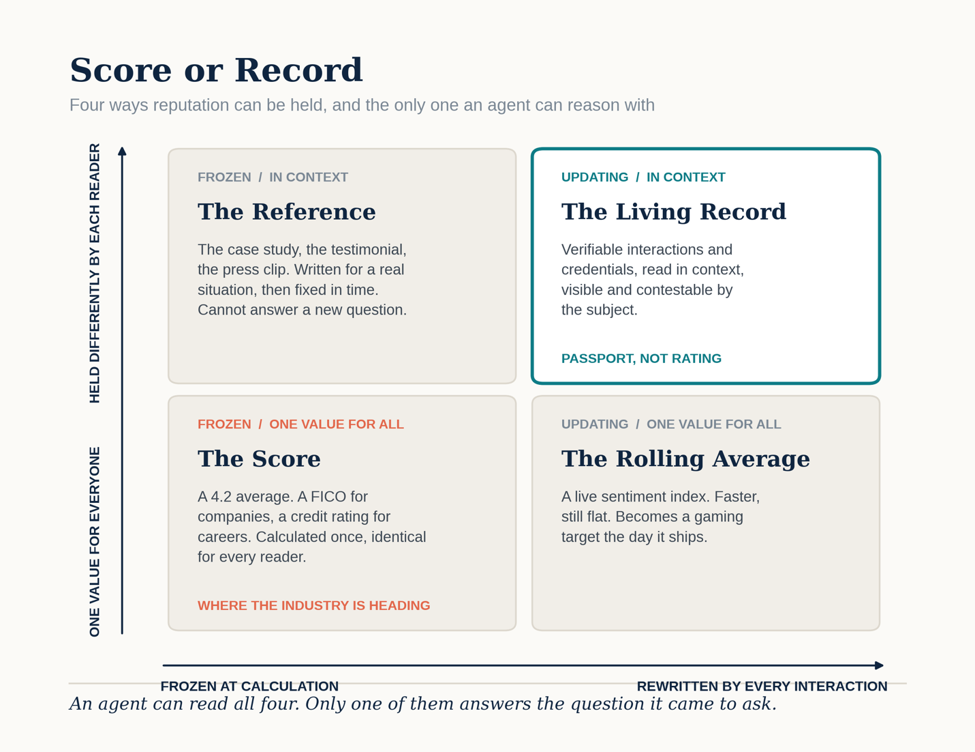
A score of 87 cannot answer that question, because an average erases the very details the decision depends on but a record of interactions can.
And there is no appeals desk for a neural network. Your reputation used to live on servers you could petition. Part of it now lives in weights nobody can inspect.
You Cannot Publish Your Way Out
Most companies will get their first move wrong, responding the way they responded to SEO, by publishing more.
Muck Rack’s May 2026 analysis of more than 25 million AI citations found that 84% of what AI engines cite is earned media. Paid content came in at 0.3%. Your website is testimony whereas earned coverage is evidence.
Trust, meanwhile, is falling as use climbs. A June 2026 Pew Research Center survey of US adults found that only 29% of chatbot users place much trust in what those tools tell them. When anyone can fabricate a press release or a video interview, verification becomes scarce, and the organizations that can prove their claims stand out.
The Wrong Turn
The industry’s reflex will be to build reputation scores. One number an agent reads in a millisecond, like a FICO for companies. The appeal is real: auditable, comparable, cheap to compute, everything a busy agent wants. It is still a category error.
The moment a metric becomes the target it stops measuring what it was built to measure, and a universal score would spawn a gaming industry within a quarter.
Black Mirror got there first with “Nosedive,” the episode where a single universal rating decides where people can live, fly, and stand in line. Worse, a single number computed by whoever owns the platform is a social credit system with better branding. What agents need is proof they can weigh in context. Think passport rather than rating.
The PROOF Framework
Probe. Audit what the major AI assistants say about your company and executives every quarter. You cannot manage an answer you have never read.
Register. Establish verified identity wherever it exists, including provenance standards such as C2PA.
Own. Publish structured, consistent facts about your organization where AI systems can find them.
Outside evidence. Third-party coverage, analyst validation, and peer-reviewed work are what AI cites, and a verifiable credential is the machine-readable form of it. A press mention says you are credible. A credential lets a machine check it.
Fix fast. Build a misinformation playbook with a speed metric. The window between a false claim appearing and being absorbed is measured in hours, not news cycles.
Where to start: run the probe yourself and treat the transcript as a board document. Assign one owner, because AI reputation falls in the gap between communications, marketing, and security, and unowned problems do not get solved. Then move budget toward earned coverage and verifiable credentials.
The Bottom Line
Reputation used to be what people said about you when you left the room. Now it is what one machine tells another before any human hears your name. The definition has not changed. Trust is still the conviction that the leader means what (s)he says, and reputation is the record of whether you did.It is the only version with room for ingenuity, for what no score has counted yet. Yours is being written either way. Map the agents already reading you and put reputation on your next board agenda.
About the author:
Sandy Carter is CEO of EQUS, an agentic AI company focused on privacy-based AI, identity, and trust infrastructure. A former AWS and IBM executive who scaled multi-billion-dollar businesses, she is the bestselling author of “AI First, Human Always” and founder of Unstoppable Women of AI. She has been named an Adweek Power AI 100 and NBC Top 13 AI Business Leaders.
One comment