
 Posted by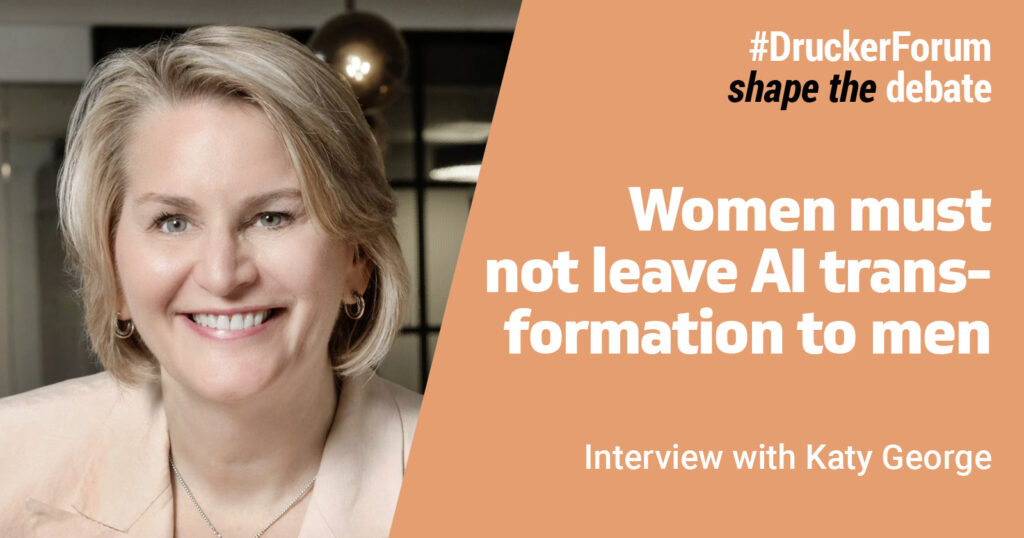
Interview was conducted by Michaela Ernst / Der Standard.
Many employees worry about how we can stop AI from replacing humans. What are the most effective ways to ensure that AI enhances human capabilities?
Katy George: From the outset teams should define which tasks must remain human – especially in decision-making – and how AI should be responsibly used. On top of that, companies need to invest heavily in empowering their employees with AI skills. The better they can utilize AI, the more it will complement rather than replace human labor. Organizations should also strategically shift human work away from routine tasks and towards higher-value activities. When AI takes over administrative or transactional tasks, people can dedicate more time to customers, creativity, and their own decision-making, which is where value is created.
Many employees report that AI speeds up their work but doesn’t necessarily make it easier. Do you see this creating new pressures?
George: The technology works so fast that people sometimes feel, for example when doing quality control, that they themselves are the bottleneck. This creates pressure. So there are situations where we need to think very consciously about the interplay of speed and capacity when we talk about future human-machine interaction.
The “efficiency limit” of AI-supported production functions is now being tested. How does AI change not only our tasks, but also the skills that will be particularly important in the future?
George: AI competence is becoming a fundamental workplace skill. People must be willing to experiment, understand, and actively work with it. Also, skills that were previously often only important later in a career are gaining in significance. These include classic management skills: precisely defining goals, structuring work, delegating effectively—whether to humans or AI agents—setting priorities, consolidating results, and ensuring quality. At the same time, the importance of systems thinking and customer-centric design is increasing. As AI takes over many analytical and operational tasks, the human role will increasingly lie in understanding what truly matters to the customer and how the overall system functions.
They also say that AI is changing not just jobs, but entire work models. Where do companies face the biggest challenges when they have to restructure both their business and their workforce simultaneously?
George: The biggest challenge is that companies have traditionally never been particularly good at workforce and skills planning. This is now made even more unpredictable by the application of AI. It’s hard to predict which new roles will emerge or how skills requirements will shift. This means that companies need more flexible talent models that allow people to realign, retrain, and identify opportunities independently. The key point is: In the AI era, there is no longer a separation between business and work transformation. Anyone who wants to use artificial intelligence must be prepared for work to be constantly reorganized – and with it, the demands placed on the workforce.
Are these changes perhaps particularly difficult for European companies because stability is traditionally valued more highly here than experimentation?
George: Europeans do indeed lack this mindset for change. They value stability and want things to stay the same. People here would need to be taught what US organizational researcher and Harvard professor, Amy Edmondson, calls “failing well.” Europeans are familiar with this concept from academia—now it’s time for them to apply it to the business world.
What leadership skills will be crucial in such a new environment in the future?
George: Essentially, they are the same things we were discussing five years ago but now feel much more relevant. The most important leadership task will be to establish a clear framework—and within that framework, to allow change, define goals precisely, and link them to business success. The key new aspect is the task of activating the entire organization as an engine of innovation. Problems often arise when AI is treated merely as the roll-out of a new tool. When employees are given access to technology without clearly defined priorities, it frequently leads to widely varying results and limited benefits. Successful transformations combine clear strategic guidelines with broad participation.
What are the three most important levers leaders can use for successful transformation?
George: I see three crucial factors. First, leaders must define what matters, what goals are being pursued, and how success will be measured. Without this clarity, technology deployment often remains fragmented and ineffective. Second, transformation works best as a simultaneous top-down and bottom-up process. Leaders set direction and priorities, while at the same time involving the entire workforce in redesigning work. Employees possess an implicit knowledge of what actually works—and what doesn’t. Third, transformation requires a systematic redesign of work, not just the introduction of new tools. Only those organizations that directly link AI to business processes, customer value, and competitive advantages will be successful.
Which leadership models no longer work in this new world of work? What must we clearly leave behind?
George: What’s clearly dying out is the idea that managers can plan the future of work in a conference room and dictate it for everyone. The world has simply become too dynamic for that. We can no longer reliably predict which jobs will emerge or which skills will dominate. Instead of static workforce planning, companies need dynamic talent systems where employees can see where opportunities lie, which skills are in demand, and actively shape their careers. The notion that transformation can be delegated to HR is also becoming obsolete. In the AI era, business transformation and workforce transformation are one and the same. They can no longer be separated.
What advice would you give to women who want to reach top management positions?
George: The most important point: Women must not leave the AI transformation to men, otherwise AI will be mistakenly perceived as a purely technical field. Today, AI is heavily based on communication, interaction, and collaboration – skills that many women possess. Companies that enable and support diversity during the transformation phase will be more successful in the long run.
Microsoft is known for its learning culture. Which learning models do you think will shape the next 10 years?
George: We are moving away from traditional learning formats towards learning by doing.
Formats like bootcamps are particularly effective, as they allow teams to collaboratively use new tools, redesign work methods, and immediately apply the learnings to real-world tasks. Fundamentally, future learning will be continuous and experimental. Technologies, processes, and roles are constantly evolving. So, people must not only do their work but also continuously develop it. In the future, everyone must not only be able to do their job but also to change it.
You once said that your most important piece of advice for success was: “Be generous!” How has this principle changed for you as a leader in the complex field of technology and transformation?
George: It has become even more important! In times of great uncertainty—due to technology, geopolitical developments, or volatile career paths—people tend to withdraw and focus more on themselves. For me, generosity means putting the team first, including others, sharing successes, and supporting people. It also creates psychological safety—which, in turn, is crucial for a willingness to experiment and learn. In a world where careers are less predictable and change is becoming the norm, generosity as an attitude is one of the most important leadership skills.
About the author:
Katy George is Corporate Vice President of Workforce Transformation at Microsoft. She leads a team focused on understanding AI’s impact on labor markets and shaping Microsoft’s workforce strategy. Previously, she was Chief People Officer and a Senior Partner at McKinsey & Company, where she led global operations and workforce research. Katy holds a Ph.D. in Business Economics from Harvard and a B.A. from Oberlin College. Her work bridges technology, labor economics, and organizational design to prepare for the future of work.
The interview was first published in German on 20 June 2026 in *Der Standard*, Vienna. The interview was conducted by Michaela Ernst.