

 Posted by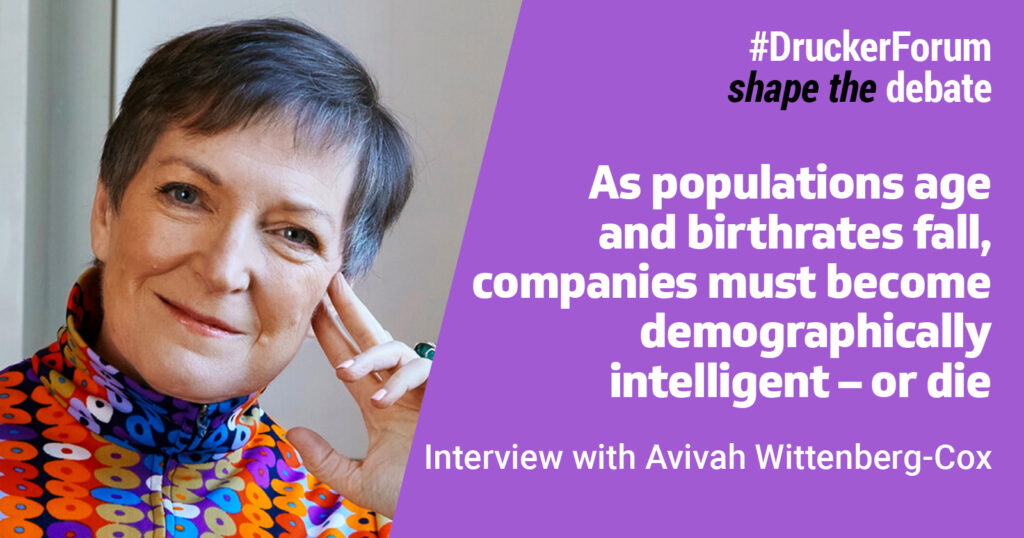
Interview was conducted by Michaela Ernst / sheconomy.
1) Many leaders treat demographics as background data rather than a strategic force. What does it mean for a company to become truly demographically intelligent?
Avivah Wittenberg-Cox: I call this becoming “longevity literate.” Companies need to become “longevity ready.” Above all, this means putting the topic on leadership agendas, because in many organizations it still is not. That is precisely what I am working on at the moment. As long as demographic change is not treated as a strategic issue, it will remain under-recognized. Yet its impact is comparable to that of climate change and artificial intelligence.
2) Why are societies so poorly prepared for this demographic shift?
AWC: It is somewhat similar to climate change. We know it is coming, but we tend to focus on short-term crises — geopolitics, economic developments, artificial intelligence. As a result, long-term developments often receive less attention.
What we need to do now — which is not difficult, because the data are very compelling — is to demonstrate how significant the longevity issue actually is. We need to train more leadership teams to put it on their radar and to assess what it means for their businesses, their talent pools, and their customers.
For companies that think ahead, this represents a significant opportunity. Some early movers are already adapting. The larger group of companies has not yet done so. The key is to frame the issue correctly — once that happens, others will follow.
3) As people live and work longer, traditional career models – education, work, retirement – no longer fit. How should leaders and HR systems adapt to a 100-year life?
AWC: I do not think we are as far away from this as it may seem, because we often speak in averages. If you look at European countries with some of the oldest populations — such as Italy, Spain, and Portugal — average life expectancy is already 80 years or more. Among educated and healthy people who take care of their health, we will increasingly see individuals living beyond 100. Over time, this will become less exceptional.
Companies, particularly those employing large numbers of knowledge workers, need to prepare for this development. I divide the concept of the “100-year life” into four quarters of 25 years: Q1 Growth / Q2 Achieve / Q3 Become / Q4 Harvest.
Today, most companies focus almost exclusively on Q2 — the years between 25 and 50. However, the real challenge, and the new element, is Q3: the healthy and productive years between 50 and 75. Companies need to expand their perspective from focusing primarily on Q2 to including both Q2 and Q3.
In practice, this means that careers will effectively become longer and more flexible. Internally, this affects talent management; externally, it also has implications for sales, marketing, product development, and innovation — all of which will need to address a broader customer base.
4) What new mindsets or leadership qualities are needed to lead in an age of demographic change and extended careers?
AWC: First, leaders need to become familiar with the data, the scale, and the implications of demographic change. This is not a distant future issue — it is already happening.
Second, leaders need to become more “multilingual” across generations. They need to understand, motivate, and communicate effectively with different age groups — using appropriate messages, communication styles, and working methods. At present, many leaders are mainly familiar with the norms of their own generation.
However, different generations have different cultural expectations. People have grown up in different contexts and have been shaped by different technologies. Organizations need to encourage learning across generations rather than mutual judgment.
5) For the first time, up to five generations are working side by side. How can organizations turn this demographic reality into a source of innovation rather than friction?
AWC: It begins with mindset. Do we see this as an opportunity? Do we recognize the large longevity economy that is emerging? Or do we perceive it primarily as a challenge and ask what to do with an increasing number of older workers?
The key step is to place the issue on the strategic agenda and for executive committees to develop a clear longevity strategy. In today’s environment, such a strategy is fundamentally a growth strategy. Companies that fail to develop one will struggle to adapt to demographic change.
6) Do you see technology, and particularly AI, as a catalyst or a challenge for longevity-ready organizations and careers?
AWC: I see AI primarily as a catalyst. Interestingly, it may affect younger people more than older ones. Older professionals often bring significant experience. They have gone through multiple waves of change and understand how systems operate.
AI may affect early-career professionals more strongly — those who traditionally spend several years learning how to grow into their roles. At the same time, I see many people over 50 using AI to develop new ideas or start new ventures.
AI is not particularly difficult to learn. It relies on asking good questions, using effective prompts, and receiving appropriate training. Many experienced professionals are particularly strong in these areas. If used responsibly — and if organizations focus more on performance and outcomes rather than bias — AI could even help reduce age discrimination.
7) You advocate for greater awareness around demographics and longevity. What developments encourage you that leaders are beginning to take this transformation seriously?
AWC: We are entering a phase in which organizations will no longer have much choice — particularly in Europe, where the younger population is declining significantly. In many countries, half of the workforce will soon be over 50.
If organizations fail to make use of this workforce, there will not be enough labor capacity to sustain economic growth.
8) Looking ahead – despite backlash and retro politics – do you see reasons for optimism that organizations will actually live the balance they talk about?
AWC: I believe organizations will increasingly be compelled to address this issue. Europe in particular is aging rapidly. Japan is already further ahead, but countries such as Italy, Portugal, and Spain are catching up quickly.
The combination of increasing life expectancy and low birth rates will require organizations to completely rethink how they structure work and careers.
About the author:
Avivah Wittenberg-Cox writes, speaks and consults about generational and gender balance – the future of work, the longevity economy, and the transformative potential of 60-year careers
The interview was first published in German on 31 March 2026 in sheconomy. The interview was conducted by Michaela Ernst.