
 Posted by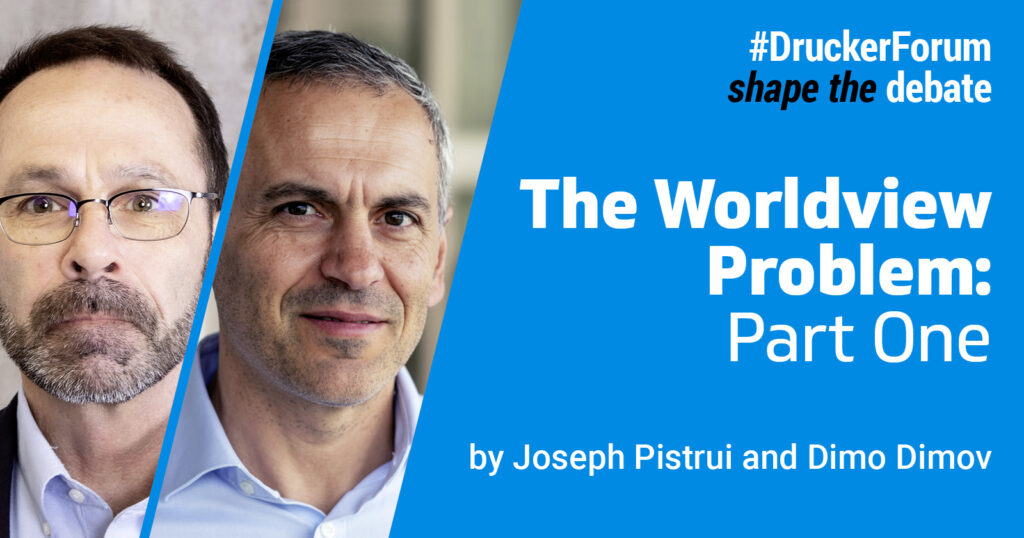
A two-part blog on the problem with the world view and the capacity beneath the strategy.
Pulling up
Facing their deepest challenges, organisations seek to pull themselves up from the vortex of disruption. The idea is seductive. It echoes the feat of Baron Münchhausen who, stuck in a swamp, pulled himself (and his horse) up by his hair. If only we can pull harder—revisit strategy, strengthen governance, elaborate plans, double effort. One can hear Archimedes laughing: he understood a long time ago that leverage needs to come from the outside.
 The trouble is, all this effort is captive to an entrenched way of seeing the world. Certain assumptions are held so deeply that they become an invisible frame through which everything else is seen and interpreted. When the frame is the problem, no technique applied within it changes the result.
What Drucker Saw
Drucker called it the theory of the business — the founding assumptions that become invisible precisely because they worked. The organisation can no longer see the frame it inhabits, because the frame has become indistinguishable from reality itself. The challenge he named was not how to build better theories. It was how to develop the capacity to see the one you are already inside.
Akin to the lens of the human eye, this frame has a limited useful span. Gradually, the world blurs and becomes less recognisable. This is not a cognitive failure but a consequence of the erosion that comes with longevity. If only we had the equivalent to cataract surgery for organisations—taking the old lens out and putting a new one in, with the world appearing new.
We can of course hang on to the old frame and work around it, using our memory as a prop for how to interpret the blurred images. We can invest to preserve the memory and drive performance as we know it. In this way, we can live blissfully in the past until we are shaken by the realisation that things are no longer as we know them.
What the metaphor leaves open is the surgeon’s role — what it takes to replace the lens and who is equipped to perform it. That is the question Part Two takes up directly.
Why Better Strategy Doesn’t Solve It
The innovation gap — the persistent distance between knowing what needs to be done and actually doing it — seems impervious to a constant churn of solutions. The lure of better frameworks, clearer strategy, more sophisticated governance, transformation programmes, innovation labs are irresistible. It fuels the hope that we can pull ourselves up. Yet, the gap persists.
The reason is not poor execution but category error. The status quo is taken as something given rather than something to be questioned. Thus, most innovation investment operates with the frame rendered invisible by the sense that this is how things are and have always been. If only an eye doctor could show an organisation’s vision to be blurred. It would be a wake-up call for renewal, for a new frame. This requires reinterpretation of the past, present, and future, emerging through interaction, not calculation. The challenge begins with different questions rather than better answers. Which commitments should be honoured, and which reinterpret? Is the next generation ready to lead — and what does ready mean when the context has fundamentally changed? These are re-framing questions, not to be tackled by expertise alone. They require something else.
Transformation fatigue is the symptom. Organisations invest heavily in change, exhaust themselves and their people in the process, and arrive somewhere that looks different but feels the same. The frame has been redecorated but kept unchanged.
Artificial intelligence intensifies this problem rather than solving it. AI is formidable within a frame — it can execute, optimise, and accelerate whatever the frame already takes as given. What it cannot do is question the frame itself. That remains stubbornly human work: the double-loop and triple-loop learning through which a system examines not just its actions but the assumptions and worldviews generating them. The more powerful our tools become, the more urgent the developmental capacity to see beyond the frame becomes.
What Follett Named
Mary Parker Follett, the thinker Drucker would later call the prophet of management, named the possibility of frame change a century ago. When people encounter genuine difference, she observed, they tend either to suppress one position or to compromise both. Neither produces anything new. A third possibility—integration—meant holding the engagement long enough for an understanding to emerge that neither party contained at the outset.
Integration is neither consensus nor compromise, but the emergence of something genuinely new from the encounter between perspectives that neither could have generated alone. This is how our eyes generate 3D vision — by integrating the difference between the two-dimensional inputs of the two retinas to create a sensation of depth.
What Follett did not fully specify — and what most renewal efforts still miss — is that the capacity for integration cannot be developed within the existing frame. It requires building different ground: the relational depth, the interpretive capacity, the coherent holding from which integration becomes possible.
Four Years, One Diagnosis
This Forum’s own inquiry has been converging on a single question for years, even when it didn’t yet have the words for it: what does it take to become generative? Wellbeing as the substrate of resilience, generativity as the necessity productivity cannot supply, the system over the individuals within it — each turn sharpened the same underlying question rather than answering it, until what remained was the one this piece takes up: what does becoming generative actually require?
The time has come to make this diagnosis explicit.
Innovation failure is not a strategy problem, but a worldview problem. The organisations that struggle to renew themselves are not, for the most part, lacking good strategies or talented people or genuine motivation to change. They are trapped inside frames they can no longer see. And the tools at their disposal cement the frames rather than dislodge them.
Drucker diagnosed the trap. Follett named the possibility. Neither fully specified the developmental ground that makes renewal possible.
The question is no longer whether organisations need new frames. The question is whether they can develop the capacity to inhabit them.
That capacity can be cultivated. Its development can be scaffolded through deliberate practice.
About the authors:
Joseph Pistrui is Senior Research Fellow at the Center for the Future of Organization, Drucker School of Management, co-founder of Generative Learning, and Professor of Entrepreneurship & Innovation at IE University in Madrid.
Dimo Dimov is co-founder of Generative Learning, Professor of Entrepreneurship & Innovation at University of Bath in the UK, and author of two books on entrepreneurship.