
 Posted by
The day before the 2025 Global Peter Drucker Forum officially began, I welcomed a small group to Peter Drucker’s family villa in Vienna. We gathered to discuss Joseph Schumpeter’s century-old insights about “creative destruction” and “intelligent monopolies,” ideas that introduced dynamics into the Austrian School’s closed economic system. The setting carried symbolic weight: discussing disruption in the very space where foundational management thinking took shape.
But what struck me wasn’t the historical resonance. It was how quickly our questions shifted from “what did Schumpeter say?” to “what do these ideas mean given the geopolitical and technological shifts we face today?” That shift from historical inquiry to urgent present-tense questioning set the tone for what followed. Over the next three days, I found myself in five distinct conversations, each offering a different vantage point on this year’s theme: “Next Era Leadership—All hands on deck.”
Five Windows, One Pattern
Hours later, in the pre-Forum workshop “The Wise Path”, experts with Chinese, Indian, European, and American roots explored philosophical traditions from Confucian ethics to yogic discipline to religious teachings. What became clear: these time-honored frameworks give leaders something to stand on while everything shifts beneath them. I presented the Wisdom Compass from my forthcoming book, Human Magic: four directional questions that translate ancient insight into contemporary practice: What is right? What works? What endures? What matters? The framework resonated because it addressed what participants were grappling with: how to preserve human judgment when algorithms optimize for efficiency alone. Looking backward, it turned out, might be the most radical act in an age obsessed with novelty.
That evening, at a dinner with prominent Indian business leaders, many representing generational family enterprises, the conversation took a different turn. Here, “ancient wisdom” wasn’t Western construct applied to Eastern traditions. It was multiple wisdom lineages in genuine dialogue, bringing both philosophical depth and operational urgency. If “all hands” truly matter, they must be global hands, bringing frameworks that challenge and enrich each other.
The main Forum session I moderated, “The CEO’s Guide to AI” with two renowned futurists and AI experts from Silicon Valley, engaged a packed room. We structured it around provocations: “AI will make CEOs more effective.” “AI will make CEO roles obsolete.” “AI will make CEOs irreplaceable—if they practice wisdom.” As senior executives engaged with technical capability, the conversation kept circling back to the morning’s themes: judgment, intuition, wisdom. The technical questions (“How do we implement this?”) quickly gave way to organizational ones (“How do we preserve what makes us distinctly human?”). Here was the gap that ancient wisdom traditions actually address: not technical implementation but preservation of human organization in an algorithmic age.
By the closing plenary, where Forum founder and president Richard Straub invited me to outline our “Next Management” trajectory, a pattern had crystallized. The guiding principles “innovation, more than efficiency”, “human augmentation, more than automation”, “management as art, more than science”, aren’t prescriptions but orientations toward uncertainty, frameworks for asking better questions together.
What struck me was the response from Fellows, Executive Council, and Special Interest Group members engaging with genuine commitment, not polite interest. Rick Goings’s appointment as Honorary Fellow symbolized generational commitment. Infrastructure is emerging to sustain conversation between gatherings, including research partnerships, expanding Drucker Salons, and AI-enabled interviews.
What Convergence Demands
Across these conversations, I kept returning to a realization our Next Management research has been circling: practitioners don’t need more competencies. They need frameworks for asking better questions and, crucially, they need to ask those questions together. The questions that matter most only emerge through sustained dialogue between those who think about management and those who live it daily.
This is what makes the Forum distinctive. It has quietly evolved into something rarer than conferences showcasing thought leaders or gatherings celebrating practitioners. It has become a research site where we observe how questions evolve through cross-pollination. The CEO wrestling with AI adoption gains vocabulary from ancient philosophy. The researcher exploring human augmentation confronts operational reality from global business leaders. The practitioner anchored in one cultural tradition encounters another.
But whether this convergence produces genuine learning community or merely sustains an annual gathering remains an open question. The infrastructure exists. The commitment is real. Yet the test ahead is formidable.
Toward Vienna 2026
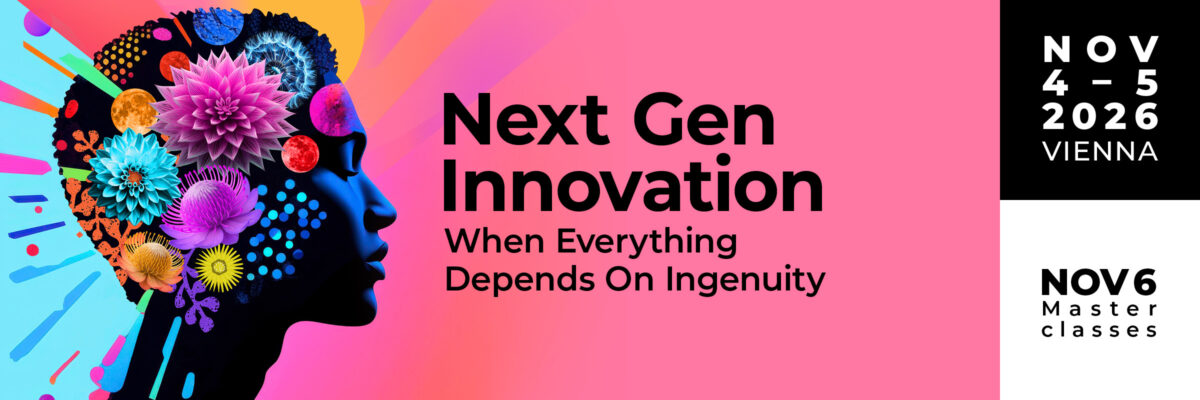
Next year’s Forum theme: “Next Gen Innovation: When Everything Depends On Ingenuity.” The Forum’s 20th anniversary in 2028 will create a natural moment for honest assessment. If everything depends on ingenuity, the real question becomes: whose ingenuity, cultivated how, and whether a community like this can develop it as fast as disruption demands it.
Schumpeter understood that destruction must precede creation. But what we’re learning in that villa where Drucker once grew up, across workshops and plenaries and late-night conversations, is that creation in the AI era requires not individual genius but collective ingenuity. Not one hand but all hands, bringing what only they can contribute.
The conversation continues. Next November, it happens again in Vienna. Whether we learn from it quickly enough remains the only question that truly matters.
About the author:
Johan Roos is executive director of the Vienna Center for Management Innovation (VCMI) and presidential advisor at Hult International Business School. His forthcoming book is Human Magic, to be published in 2026.