
 Posted by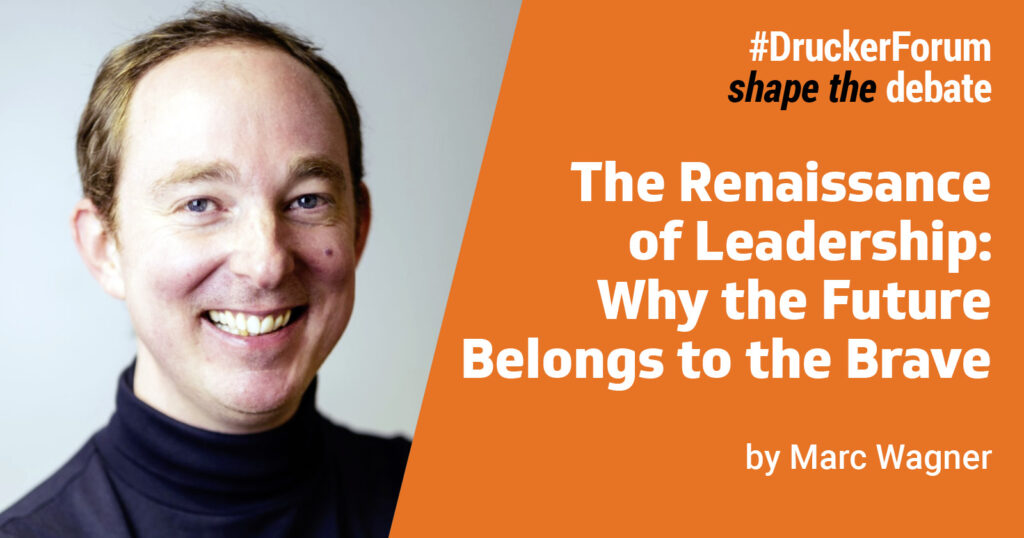
“The best way to predict the future is to create it.” — Peter Drucker
This year’s Peter Drucker Forum poses a defining question: “Next Gen Innovation – When Everything Depends on Ingenuity.” I want to put an uncomfortable thesis on the table: the greatest barrier to innovation in most organizations is not a lack of technology. It is a lack of leadership.
We live in a BANI world – brittle, anxious, non-linear, incomprehensible. A world in which human knowledge, according to some estimates, doubles every twelve hours in certain fields. A world in which 65 percent of today’s primary school children will hold jobs that do not yet exist. In such a world, being good at managing is no longer enough. What we need are people willing to lead – with courage, empathy, and a genuine desire to shape what comes next.
Management gets automated, leadership stays human.
This is the pivotal insight at the heart of the digital renaissance – and it reframes the entire innovation debate. For decades, we assumed automation would take over physical labour while humans focused on creativity and strategic thinking. The reality has inverted our expectations: AI systems write poetry and generate code, while humans still unload the dishwasher. ChatGPT, Claude AI, and Gemini have moved into cognitive territory we once considered exclusively ours.
And yet this is not a defeat. It is a clarification. Because what AI cannot do – what it will never do – is inspire. It cannot build trust between people. It cannot lead a team through a crisis with empathy and moral courage. It cannot make a colleague feel seen, valued, and motivated to give their best. These are the irreducibly human dimensions of leadership.
This is the great divide of our era: management – planning, budgeting, optimising, controlling – is increasingly automatable. Leadership – guiding people toward a vision, fostering psychological safety, building high-performing teams, making values-driven decisions – remains stubbornly, beautifully human. The leaders who thrive in the coming decade will be those who understand this distinction viscerally, and who invest their energy accordingly.
The end of control – and the start of something greater
For too long, we equated leadership with control. With predictability. With hierarchy. That equation no longer holds. Decentralised networks beat hierarchies. Haier demonstrates this with 80,000 people organised into more than 4,000 self-managed teams. Supercell has proven that teams of fewer than 10 people can make strategic masterstrokes – when you trust them to do so. Gore operates on the principle of a lattice rather than a ladder, capping units at 150 people to preserve the human-scale relationships that make real collaboration possible.
These are not soft experiments in organisational design. They are competitive weapons. And they rest entirely on a leadership culture that replaces control with trust, bureaucracy with clarity of purpose, and hierarchy with clearly defined roles.
Ingenuity requires trust, not just process
The Drucker Forum 2026 asks what conditions allow human creativity to truly flourish. My answer is unambiguous: it starts with trust. Not naive trust that tolerates incompetence – but the robust trust that emerges from credibility, reliability, and genuine care for people.
The killer of every leadership claim is self-orientation. People sense immediately whether a leader is genuinely there for the team – or merely for their own career. And in a world where mediocrity is increasingly available for free through AI, authentic leadership is no longer a “nice to have.” It is the decisive currency.
“Trust will be destroyed if people smell that you do things only for yourself.” — The Trusted Advisor
AI as colleague, not competitor
The organisations that will win the next decade are not those that deploy the most AI. They are those that combine human ingenuity with machine intelligence most effectively. The unprecedented investments being made in AI will pay off dramatically only if they enable innovation – not just automation.
High-performing teams of the future will blend psychological safety with human-AI diversity, clear roles with situational leadership, shared vision with precise AI interaction. Language becomes a superpower – the interface of a new era. The leader’s job is to create the conditions in which this creative synthesis can happen.
This requires a new leadership DNA – four dimensions that must work in concert:
- Cognitive: Systems thinking and ambiguity tolerance – the ability to navigate contradictions without dissolving.
- Human: Emotional intelligence and empathetic communication – because inspiration cannot be automated.
- Tech: AI fluency and digital literacy – not as an end in themselves, but as a prerequisite for relevant leadership.
- Communication: Storytelling and precise AI interaction – because language is the new operating system of leadership.
The hard truth: those who deliver mediocrity across these four dimensions will become replaceable. Not by machines – but by people who use machines better.
Beyond method, innovation takes courage
The Forum asks how innovation can become a durable organisational capability. My thesis: it is not primarily about design-thinking workshops or corporate accelerators. It is about a leadership culture that holds two things in tension simultaneously: tolerance for failure alongside radical feedback; psychological safety alongside clear accountability; flat hierarchies alongside strong leadership.
Innovation without discipline is chaos. Discipline without innovation is irrelevance. The art lies in living both at once – and creating an environment in which people are able to do the same. That is not a management task. It is a leadership challenge.
Windows or walls: the choice Is ours
“When the winds of change blow, some build windmills, others build walls.” This ancient Chinese proverb cuts to the heart of where we stand. The digital renaissance is not a threat to human leadership. It is its greatest test – and its greatest opportunity.
An opportunity for a new form of human flourishing. For organisations genuinely built around people rather than processes. For leaders who understand that, as Peter Drucker always insisted, the purpose of an organisation is to make human strengths productive and human weaknesses irrelevant.
Zhang Ruimin, the visionary CEO of Haier, captures it precisely: people are not a means to an end – they are the end. Our goal as leaders must be to enable every person in our organisation to realise their full potential.
This is not soft social romanticism. It is the hardest and most important task of leadership in a world where everything depends on ingenuity.
“We want to encourage employees to become entrepreneurs because people are not a means to an end but an end in themselves. Our goal is to let everyone become their own CEO – to help everyone realize their full potential.” — Zhang Ruimin, CEO Haier
The renaissance of leadership has begun. The only question is: are you building windmills – or walls?
About the author:
Marc Wagner is co-CEO of Lucke GmbH and executive advisor to Atruvia AG. He specialises in digital transformation, employee experience and company renaissance.